In brief
A good reskin preserves reliable implementation while giving the game a coherent new identity. It is not a global image replacement. You must account for symbol meaning, animation structure, layout, audio, rules and asset rights—and separately consider whether the resulting game is eligible for Stake.
- Keep technical IDs stable unless the mechanics change.
- Design the whole visual family before exporting individual assets.
- Review moving assets across their full animation, not only the first frame.
Distinguish three kinds of change
| Change | Example | What must be retested |
|---|---|---|
| Presentation | Replace an ordinary symbol's drawing | Loading, size, animation, recognition |
| Interface | Reorganize mode cards and confirmation | Input, layout, accessibility, displayed cost |
| Game design | Add a multiplier or change a trigger | Math, events, rules, frontend, every affected mode |
The third category is not “just a reskin.” It requires a new mathematical and behavioral review. Likewise, a licensed existing game is not automatically acceptable as an Engine submission; revisit the originality discussion in part 1 before treating a marketplace source as a submission base.
Build an art specification, not a moodboard alone
For Harbor Signals, write down material choices, silhouette language, lighting direction, camera angle, outline treatment and the hierarchy between ordinary, premium and special symbols. A weathered-metal compass and a flat neon badge will not feel related merely because both are blue.
Create a contact sheet at the actual smallest display size. Premium symbols should remain distinguishable from ordinary symbols without requiring tiny lettering. Test in grayscale as a useful diagnostic for value contrast; do not use color alone to convey an important state.
Give the background less contrast around the board and controls. The player's first task is understanding the game, not admiring an illustration behind unreadable payouts. Define separate landscape and portrait crops instead of stretching one composition into both.
Inventory the assets before replacing them
The pinned lines asset manifest contains different asset types and aliases, including skeletons, atlases, sprites and fonts. Replacing only a PNG can leave a skeleton or atlas pointing at the wrong region.
Create a table with internal alias, visual meaning, source file, exported files, expected animation names and rights record. For example, H1 may map to a compass illustration and its idle/win sequences. The frontend's expected animation names must agree with the export; do not rename one side casually.
Preserve the editable master separately from the optimized game export. Exclude master artwork, unused variants and private reference material from the final public bundle.
Reskinning an existing Spine skeleton
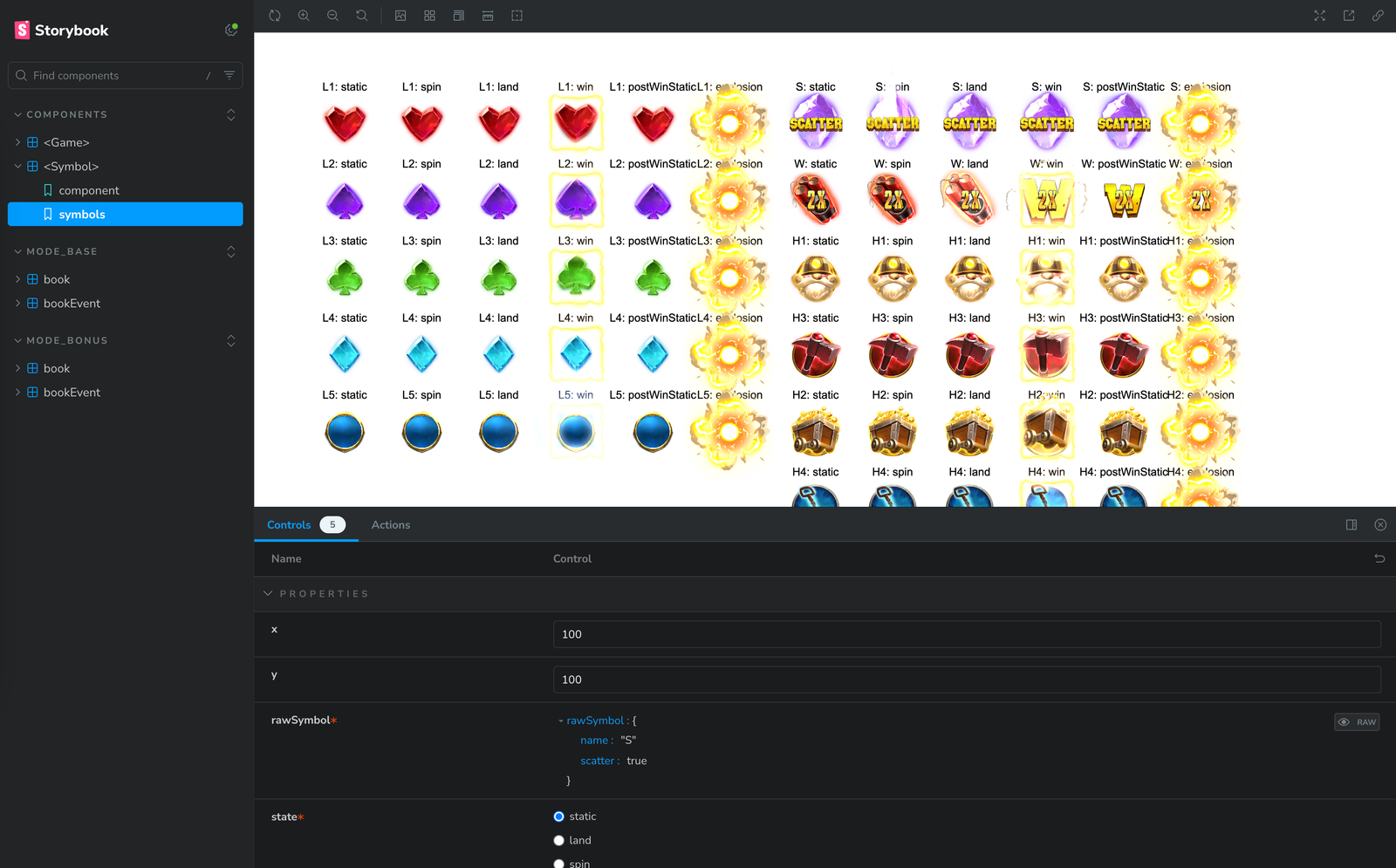
First inspect the setup pose and every important animation. Identify attachment boundaries, pivot positions, meshes, masks, draw order and deformation. Export a contact sheet of representative poses before planning the replacement.
If the replacement has the same structure, you can often preserve attachment names and rig organization while updating artwork and fit. If the silhouette changes substantially—a short sleeve becomes a flowing coat, for example—the existing mesh and weights may no longer make sense. Rework the attachment and deformation rather than forcing the new art into old rectangles.
A first-frame comparison can reveal framing and style problems. It cannot establish that elbows, overlaps, cloth deformation or off-screen effects behave correctly throughout the animation. Automated slicing should be treated as an intermediate output to inspect, not a finished rig.
The Spine/Pixi runtime documentation explains the exported skeleton and atlas workflow. Keep the editor and runtime version relationship explicit, as discussed in part 8.
Avoid the generic AI look through production choices
Whether the initial sketch came from a person or a tool, give final production an intentional art direction. Remove contradictory lighting, inconsistent perspective, illegible details and mismatched surface treatment. Hand-adjust silhouettes and spacing where the final display demands it.
Replace interface symbols with appropriate reusable icons or custom game UI artwork. Do not paste unrelated emoji, gradients and glow effects over a generic background and expect that to become a premium visual system. Keep effects subordinate to information.
Source or commission audio as a coherent set too: spin start, reel stop, ordinary result, feature transition and music should agree in tone and loudness. Track permissions for sound, fonts and textures as carefully as for the large illustrations.
The replacement test
Run exactly the same stored outcomes before and after the visual change. The payout, event sequence and mode cost should match. Inspect ordinary symbols beside wilds and scatters; ensure no new art implies a rule the game does not implement.
Check atlas edges, transparent fringes, clipping during extreme poses, loading errors and portrait cropping. The Engine frontend requirements specifically reject the sample game's visual/audio assets as final submission material, so audit the entire bundle, including loading screens and overlooked sound effects.
Finish this part
Deliver a consistent contact sheet, editable masters, tested exports and an asset-rights inventory. A successful visual reskin improves clarity and identity while leaving the intended game behavior intact; it is not evidence of automatic platform approval.